“Tonal Allegory” in Bach’s Recitative
BWV 245.36 “Die Jüden aber, dieweil es der Rüsttag war”
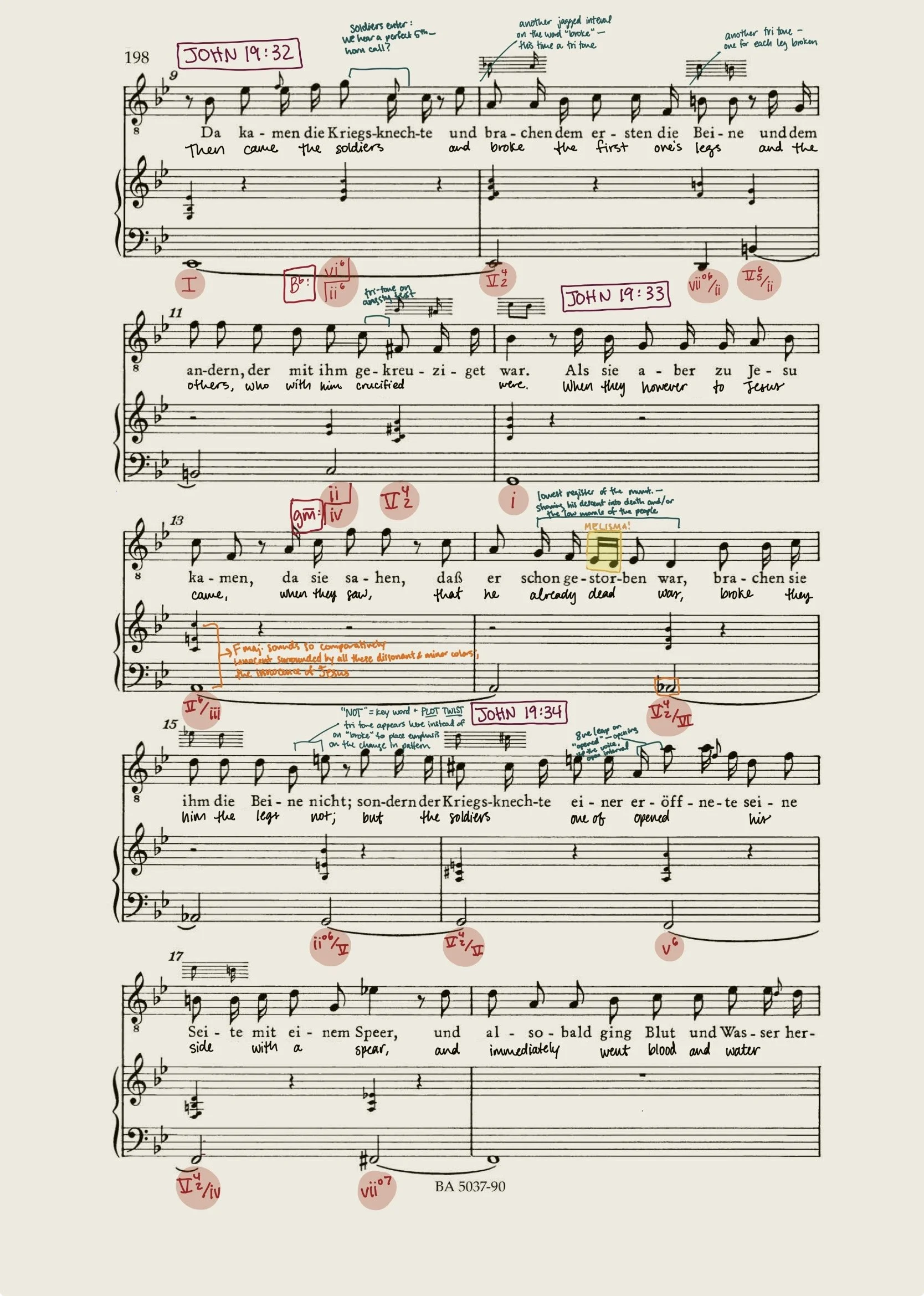
In Movement 36 of the St. John Passion, the Evangelist recounts a pivotal moment from John 19:31–37. The narrative unfolds in the immediate aftermath of the crucifixion: because it is the Preparation Day, the bodies must be removed quickly. The soldiers break the legs of the two criminals—but when they come to Jesus, they find that he is already dead. Instead, one pierces his side, and “blood and water” flow out. It is a moment of both physical finality and theological significance, one that Bach treats with striking musical care.
To understand how this care manifests, it is useful to introduce a concept central to Eric Thomas Chafe’s reading of Bach’s Passion settings, which he calls “tonal allegory”.
“The term ‘tonal allegory’ has been chosen to broaden the frame of reference for the subject [the figurative use of tonality and its association with theology in the music of J.S. Bach]. The figurative dimension of musical thought, theology and hermeneutics, and the philosophy of art meet in this shared concern with allegory. Allegory expresses the spiritual life, a way of thought in music, and in the other arts, as well as religion, and it is fundamental to my argument that tonality acts as a central, if not the central, means by which music becomes allegorical.” (vii)
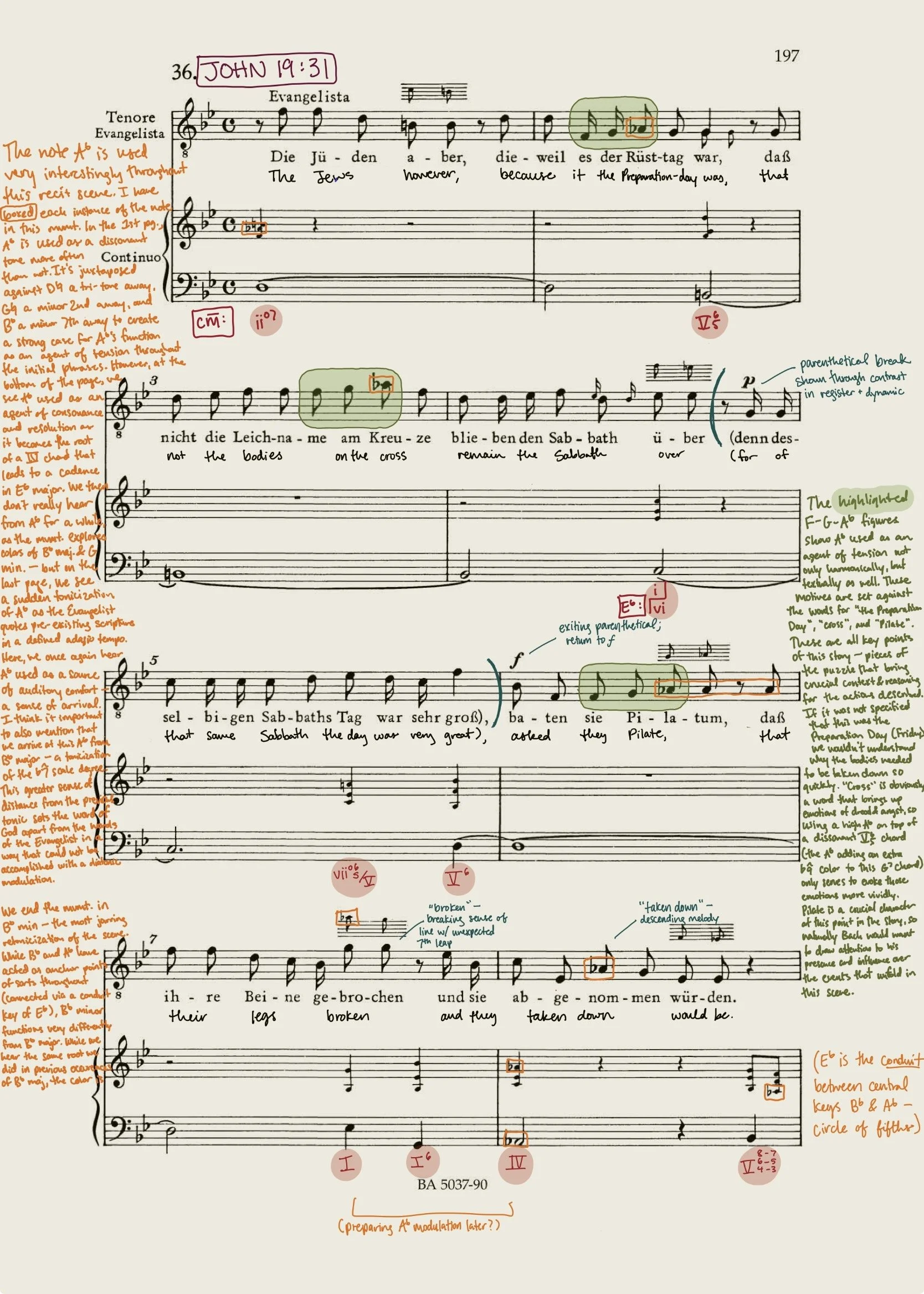
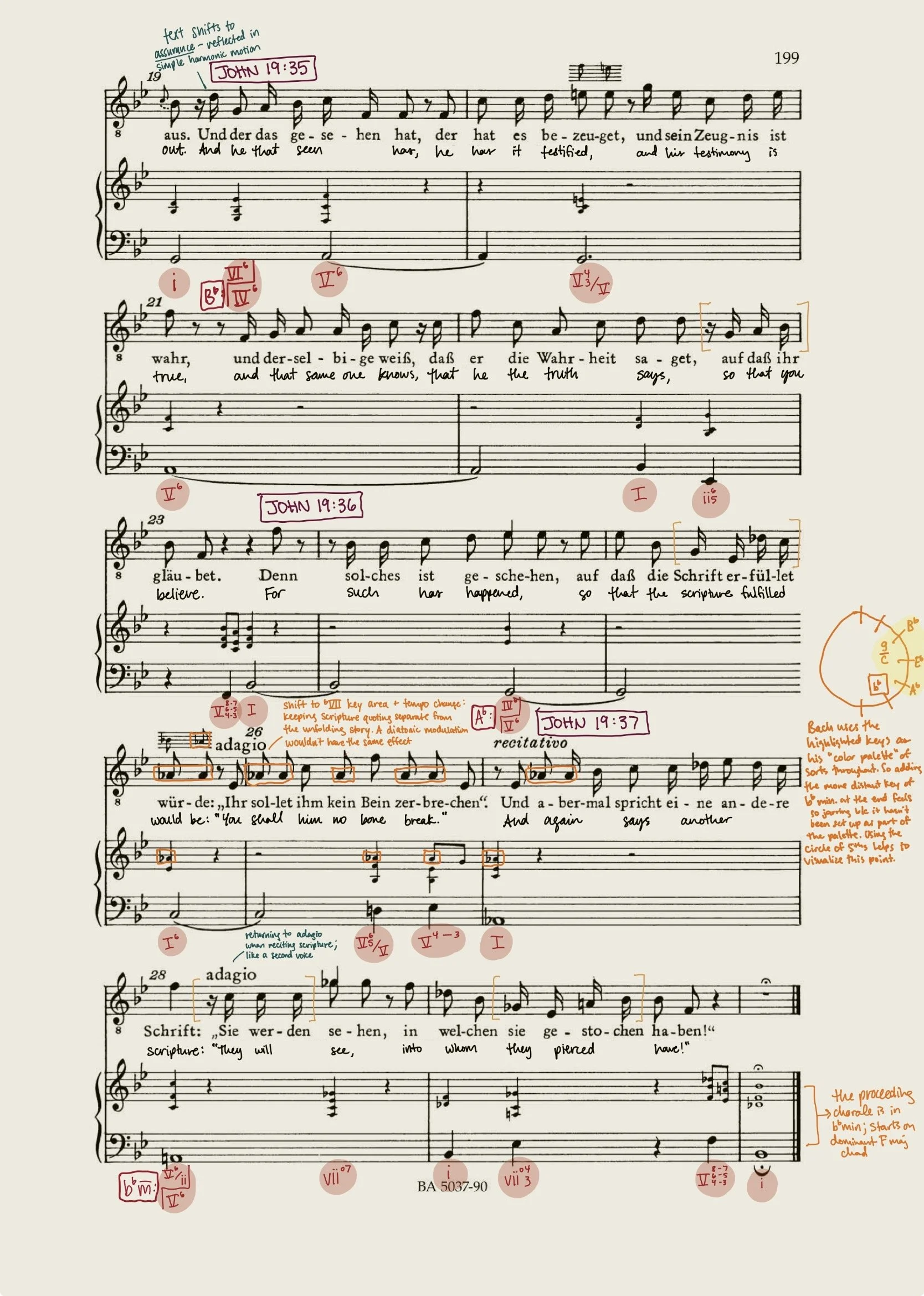
In this recitative, Bach’s use of tonality is anything but neutral. We begin in C minor and move through a range of closely related keys before arriving, decisively, in the more distant key of B-flat minor. As Chafe explains, this trajectory is rather symbolic:
“The principle of sharp/flat antithesis allowed Bach to allegorize the ideas of John’s theology in the structure of the Passion as a whole. In general, when we examine the roles assigned to flats and sharps respectively, we find that they bear a striking association to the Johannine worlds of below and above, or the realms of flesh (flats) and spirit (sharps). The scenes of Jesus’ capture, scourging, crucifixion, and burial are all in flats, with special modulations into deep flats for the narrative of the crucifixion itself (B flat minor), the reference to Judas (F minor), the Ecce homo (F minor), the interpretation of the fact that Jesus’ legs were not broken and the piercing of his side (B flat minor)...” (315)
The ending of this recitative in B-flat minor is therefore highly significant. It represents the deepest journey into the flat side of the tonal spectrum within the Passion—a musical descent into the realm of flesh, suffering, and death. Chafe continues:
“Of the remaining three symbolic modulations, one (the final turn to flats) is associated with the outbreak of natural events after Christ’s death, in particular the rending of the veil of the temple...its rending signified the breakdown of the absolute division between the realms of flesh and spirit, putting an end to the ‘old way’ of sin…The rending of the veil…might thus have been intended to signify the opening of a new spirituality in the realm of the flesh (flats)—for man. Certainly, the final flat-key segment of the Passion contains the flattest movements in the work—‘Zerfliesse, mein Herze’ (F minor) and ‘O hilf, Christe’ (F Phrygian)—the latter following from the B flat minor ending of the narrative of the piercing of Jesus’ side, a narrative traditionally associated with the flesh via the sacraments.” (323)
Within this broader tonal framework, Bach also employs recurring melodic figures as agents of meaning. Early in the recitative, the three-note motive F–G–A♭appears repeatedly at structurally and textually significant moments. This figure is set to the words “Rüsttag” (Preparation Day), “Kreuze” (cross), and “Pilatum.” Each of these carries narrative weight, and Bach’s use of a consistent melodic gesture helps to unify them. They are all key points of this story—pieces of the puzzle that bring crucial context and reasoning behind the actions that unfold in this scene. If it was not specified that it was the Preparation Day (Friday), we wouldn't understand why the bodies had to be taken down so quickly. "Cross" is obviously a word that brings up emotions of dread and angst, but in this Johannine context, triumph and redemption as well. Pilate is a crucial character at this point in the story, so naturally Bach would want to draw attention to his presence and influence over the events that transpire in this scene. Harmonically, the A♭ often functions as a point of tension—particularly in m. 3, where it appears above a dominant harmony to create a dissonant added flat-nine sonority.
The pitch A♭ in particular plays a shifting symbolic role throughout the movement. In its early appearances, it is frequently dissonant, clashing with surrounding tones such as D natural or G natural. In m. 8, however, it assumes a more stable function, becoming the root of a IV chord that leads to a cadence in E-flat major. Later, in the final portion of the recitative, A♭ is tonicized as the Evangelist quotes scripture in a marked adagio. Here, the same pitch that once signaled tension becomes a point of arrival and repose. I think it important to also mention that we arrive at this A flat from B flat major: a tonicization of the flat-seven scale degree. This greater sense of distance from the previous tonic sets the (quoted) word of God apart from the words of the Evangelist in a way that could not be accomplished with a diatonic modulation.
Other moments of melodic symbolism reinforce this approach. When the Evangelist describes the breaking of the criminals’ legs, the word “brachen” (break) is consistently set to dissonant sevenths and tritones that disrupt the melodic line. The word “Kriegsknechte” (soldiers) is outlined by a perfect fifth, evoking a horn call. And on the phrase “daß er gestorben war,” the melody descends to its lowest point in the movement, with the word “gestorben” extended in melisma—a marker of emphasis in Bach’s recitative writing. Each of these gestures brings the text to life in sound, making the recitative an active part of how the story is told rather than a passive, conversationally stylized movement.
These tonal and melodic details reveal a level of intentionality that goes far beyond simple declamation. In Movement 36, Bach’s recitative writing emerges as deeply expressive and symbolically charged. The narrative of Christ’s death is not only told. It is shaped, colored, and interpreted through the language of music itself.
The annotated score here highlights these moments in detail, tracing the interaction between text, tonality, and melodic gesture.