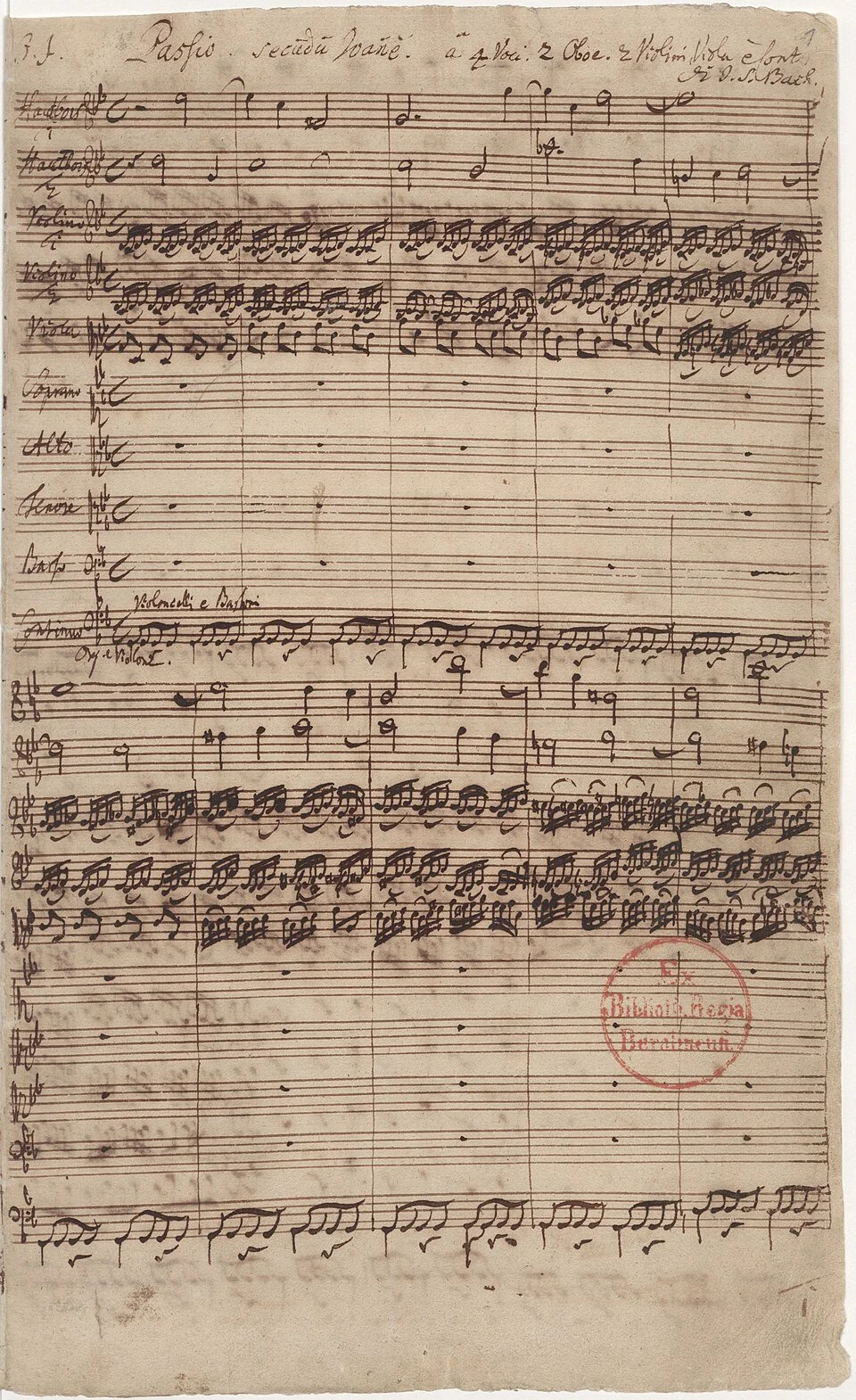
A Singer’s Guide to Bach’s St. John Passion
This project explores selected movements from Bach’s St. John Passion through a performer-scholar lens, combining musical analysis with practical insights from the stage. Each study highlights a different aspect of Bach’s composition, from imitative structure and harmonic design to text painting, symbolism, and the interpretive demands placed on singers. Through several mediums (including annotated scores, recorded performances, and interviews with experienced artists), the project aims to construct a bridge between analysis and performance.
Project Introduction and Overview
Selected Movements

Works Cited
Chafe, Eric Thomas. Tonal allegory in the vocal music of J.S. Bach. Berkeley: University of California Press, 1991.
“Johannes-Passion BWV 245.” Bach Cantatas Website. https://www.bach-cantatas.com/Vocal/BWV245.htm.
Marissen, Michael. Lutheranism, anti-Judaism, and Bach’s St. John Passion: with an annotated literal translation of the libretto. New York: Oxford Univ. Press, 1998.
“O Hilf, Christe, Gottes Sohn.” Netherlands Bach Society, April 10, 2025. https://www.bachvereniging.nl/en/bwv/bwv-1084.
Riedel, Eric, and Daniel Weeks. An interview regarding Bach’s “Erwäge,” April 20, 2026. https://docs.google.com/document/d/1uJHqCyIZWCuFxDq3zjb4xo2nECuPGIjH3VdTNTaV6mk/edit?usp=sharing
Riedel, Eric, and Joe Miller. An interview regarding Bach’s “Es ist vollbracht,”April 29, 2026. https://docs.google.com/document/d/1jI_AbTKKfY40RsAi4Xb6NG4p711eYN_V0JUE6iGB6_4/edit?usp=sharing
Steinitz, Paul. Bach’s Passions. New York: Charles Scribner’s Sons, 1978.
Vollständiges Marburger Gesang-Buch: Zur Uebung der Gottseligkeit, in 615 christlichen und trostreichen psalmen und gesängen. Philadelphia, PA: Carl Cist, 1799.
Willner, Channan. “More on Handel and the Hemiola.” Music Theory Online 2, no. 3 (March 1996).
Acknowledgements
This project would not have been possible without the support, generosity, and guidance of several people to whom I am deeply grateful.
To Sam Reenan: thank you not only for serving as the advisor for this Independent Study, but for being an invaluable presence in the modern landscape of music theory and its pedagogy. Your work at both Miami University and the University of Cincinnati College-Conservatory of Music has shaped the way I think, write, and listen. I am especially grateful for your patience, flexibility, and remarkable generosity as this project evolved (often unpredictably) over the course of my time studying with you.
To Daniel Weeks and Joe Miller: thank you for your contributions to this project through your interviews, but even more for your impact on my development as a musician. Your guidance, musicianship, and generosity have shaped not only my understanding of Bach, but my approach to performance more broadly. I am grateful for the opportunities you’ve given me, the lessons that will stay with me for a lifetime, and the many moments of shared music-making, conversation, and (of course) coffee that have defined my time at CCM.
To Olivia Knutsen, Rupert Peacock, and Maren Hrivnak: thank you for your artistry, your willingness to sightread a Bach chorale at 10 a.m. during finals week, and most of all for your friendship. Your support has meant more than I can adequately express. I am incredibly fortunate to have made music with you, and to continue making music with you.