Tracing Hymn Origins and Reiterations
BWV 245.37 “O hilf, Christe, Gottes Sohn”
The tune associated with “O hilf, Christe, Gottes Sohn” has a long and layered lineage. Its origins lie in the Latin hymn ‘Patris sapientia, veritas divina,’ a chant melody that circulated in the late medieval period. In 1531, the Bohemian hymn writer Michael Weisse (c. 1480-1534) produced a German adaptation of this material, publishing the hymn “Christus, der uns selig macht.” In this version, Weisse paired a free translation of the Latin text with a melody derived from the earlier chant tradition (Steinitz).
Figure 1 to the right is an excerpt from the Vollständiges Marburger Gesang-Buch, a German Lutheran hymnal published by Carl Cist in 1799. Upon examining Hymn 49, “Christus, der uns selig macht,” one will notice that the eighth verse of the hymn is “O hilf, Christe, Gottes Sohn.” This is the origin of Movement 37’s text.
By the late sixteenth century, the melody had already begun to evolve through successive publications and adaptations. According to scholar Paul Steinitz, the version Bach ultimately inherited wasn’t based on Weisse’s original 1531 setting, but on a later adaptation by Sethus Calvisius, published in Leipzig in 1598. What we hear in the St. John Passion, then, is not a fixed object, but the result of a long process of transmission and transformation. The chorale melody has already passed through multiple hands, languages, and contexts before it ever reaches Bach.
Following the death and burial of Christ in the St. John Passion, Bach inserts a brief moment of stillness: the chorale “O hilf, Christe, Gottes Sohn.” Placed between two Evangelist recitatives, it interrupts the Passion narrative as we near its end and turns inward. Where the recitative tells us what happened, the chorale asks the congregation how to respond. But this chorale is more than a moment of pause: it is a point where centuries of musical tradition converge in the act of prayer.
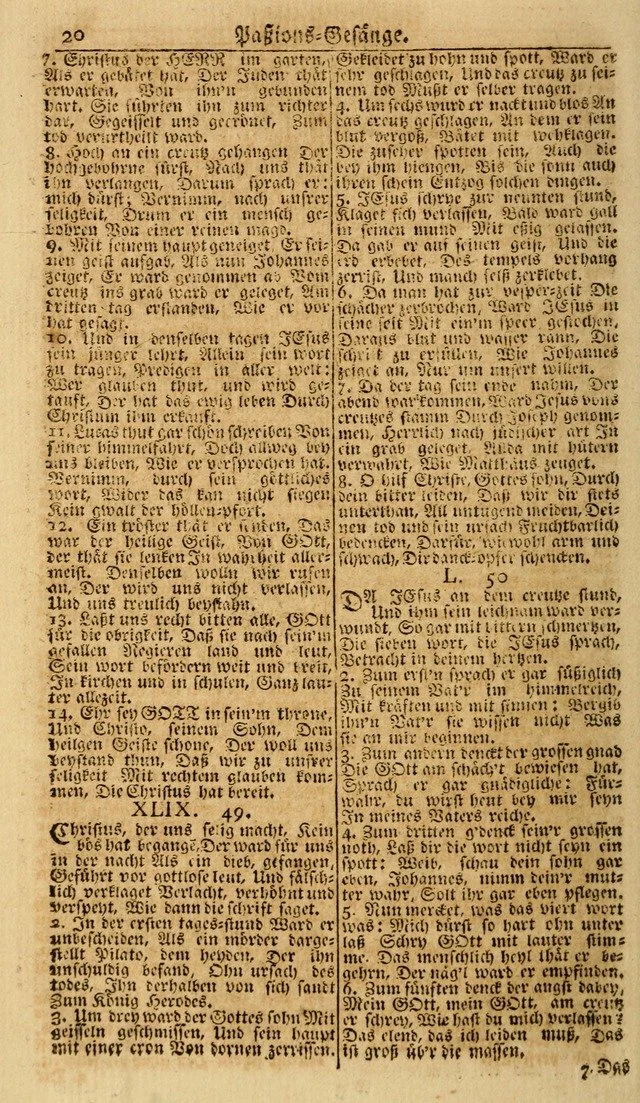
Figure 1
The earlier appearance of the hymn (Movement 15) sets the first verse “Christus, der uns selig macht” in the key of a minor. Later in Movement 37, the same melody returns with new text, transposed up a semitone to b-flat minor. The melodic material remains essentially unchanged, but the shift in key and subtle changes in voicing heighten the drama in the latter iteration.
This reuse isn’t unusual in Bach’s practice—chorale melodies were, of course, part of a shared musical vocabulary. In fact, this kind of repetition appears throughout the St. John Passion: Movements 3 and 17 both draw on the hymn “Herzliebster Jesu, was hast du verbrochen,” while Movements 14, 28, and 32 share the tune “Jesu Leiden, Pein und Tod.” In this context, the return of “Christus, der uns selig macht” in Movements 15 and 37 is not an isolated gesture, but part of a larger strategy. By reintroducing familiar material at key moments, Bach creates a sense of continuity that binds the Passion together, even as the narrative moves towards its conclusion.
The story of this chorale doesn’t end with the St. John Passion, though. Like many of Bach’s chorale settings, it continued to circulate and evolve over his lifetime. His “Christus, der uns selig macht” setting was later reharmonized and catalogued as a standalone chorale under BWV 283.
The “O hilf, Christe, Gottes Sohn” setting was similarly reharmonized and catalogued as BWV 1084. This later version, shown in Figure 2, is particularly notable for its harmonic sparseness. Many of the chords omit their thirds, creating an open, almost ambiguous sound. According to the Netherlands Bach Society, this reharmonization was likely included in the unfinished St. Mark Passion (BWV 1116.2), possibly by the composer Gottfried Keiser. Whether or not Bach himself was responsible for this version, it shows how fluid these materials remained even within his immediate circle.
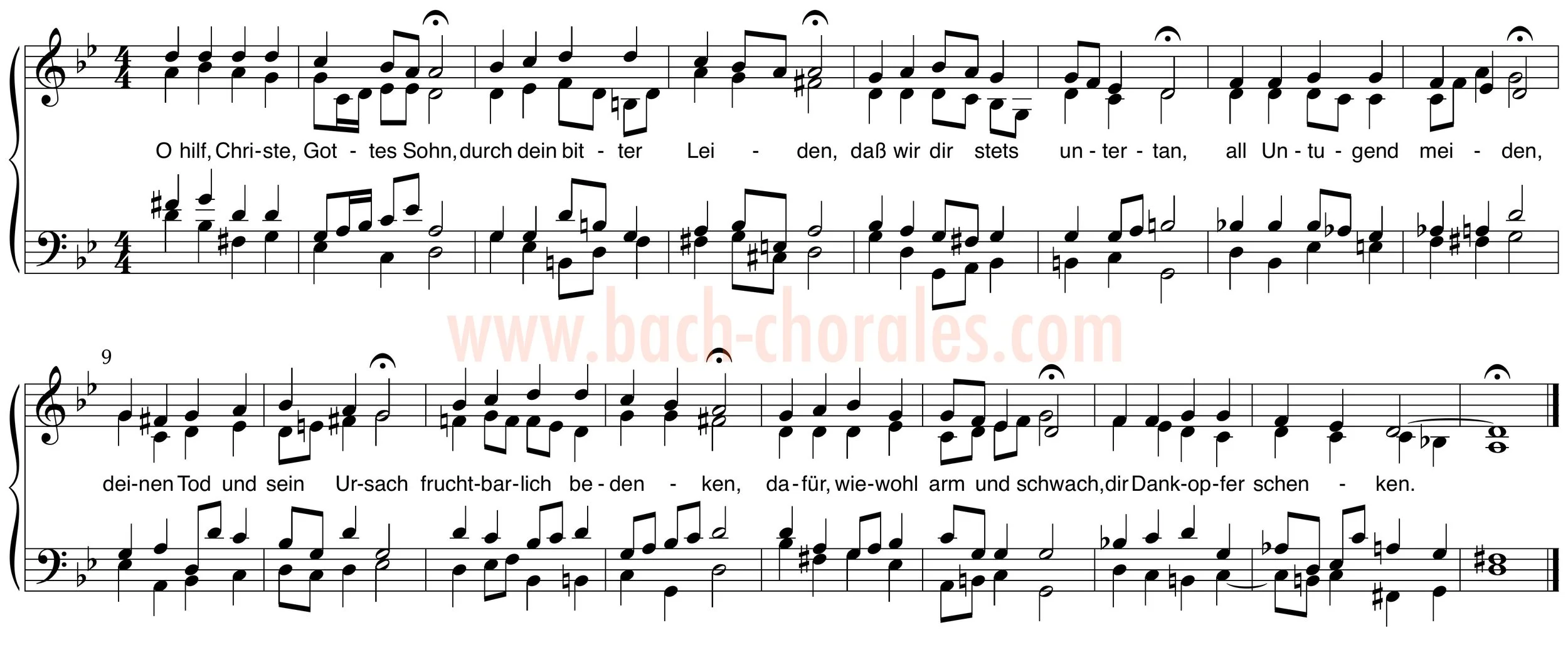
Figure 2
Taken together, the layers of text, melody, and setting help explain the role of Movement 37 within the St. John Passion. While the chorale may first appear to be a simple insertion between narrative events, it is in fact a convergence point where historical tradition and present drama meet. In performance, this connection should be felt: the chorale builds upon the foundation established earlier in Movement 15’s “Christus, der uns selig macht,” with the congregation now having gained the dramatic perspective of witnessing Christ’s death on the cross.
The performance below presents this chorale in its simplest form: four voices, singing together in the same space. Stripped of orchestral context, the focus shifts entirely to the melody, the harmony, and the collective sound of the ensemble. This recording was made in collaboration with my friends Olivia Knutsen, Maren Hrivnak, and Rupert Peacock, whose musicianship and generosity made this project possible.
If the chorale functions as a moment of communal reflection within the Passion, then this recording offers a chance to experience that function directly. Rather than analyzing the music from a distance, I invite you to step into it—joining, in a small way, the long tradition of voices that have sung it before.
O hilf, Christe, Gottes Sohn,
Durch den bitter Leiden,
Daß wir dir stets untertan
All Untugend meiden,
Deinen Tod und sein Ursach
Fruchtbarlich bedenken,
Dafür, wiewohl arm und schwach,
Die Dankopfer schenken!
O help, Christ, Son of God,
through your bitter suffering,
that we, ever to you submissive,
may shun all [spiritual and moral] failing,
[and] your death and the reason for it
fruitfully consider,
— for which, though poor and weak,
[we] give you a thanksoffering!
“Lutheranism, Anti-Judaism, and Bach’s St. John Passion” (Matthew Marissen)