Imitation, Sequence, and Theological Tension
BWV 245.1 “Herr, unser Herrscher”
From its opening measures, “Herr, unser Herrscher” establishes a sound world that feels unsettled. The orchestra pulses relentlessly, the chorus enters in overlapping waves of imitation, and the harmonic language leans heavily into minor-mode tension. And yet, the text proclaims something entirely different: the majesty and glory of Christ.
This tension is not accidental—it is the point. Musicologist Eric Thomas Chafe notes:
“‘Herr, unser Herrscher’ is Bach’s attempt to express glory and triumph within a movement that has all the outward signs of lamentation—minor key, descending minor triads, chromaticism, throbbing pedal tones, dissonances, and the like.” (285)
“The Christological portrait of Jesus accompanying these ideas combines Jesus’ divinity and his humanity, the latter emphasized throughout the Passion by minor keys, and the former emerging most strongly in major keys at the point of his death. ‘Herr, unser Herrscher’ is in a minor key, not because it is a chorus of lamentation, which it is not, but because it portrays divinity from the human perspective.” (286)
The result is a paradox: music that sounds like lamentation paired with a text that insists on triumph.
This article argues that Bach resolves this tension not be smoothing it over, but by building it into the structure of the music itself. Through the use of imitation and sequence, Bach generates a sense of forward motion and inevitability that drives the music beyond its surface affect. These compositional techniques do more than organize the chorus; they project a theological idea, one in which suffering and glory coexist, and in doing so establish the dramatic and spiritual world of the St. John Passion from its very first measures.
Herr, unser Herrscher, dessen Ruhm
In allen Landen herrlich ist!
Zeig uns durch deine Passion,
Daß du, der wahre Gottessohn,
Zu aller Zeit,
Auch in der größten Niedrigkeit,
Verherrlicht worden bist!
Lord, our ruler, whose praise
is glorious in all the lands!
Show us through your Passion
that you, the true Son of God,
at all times,
even in the greatest abasement,
have been glorified!
“Lutheranism, Anti-Judaism, and Bach’s St. John Passion” (Matthew Marissen)
From the outset, the text establishes the central paradox of the St. John Passion: Christ’s suffering doesn’t stand in opposition to his glory. It’s how that glory is made visible. The language moves quickly from proclamation (“dessen Ruhm… herrlich ist”) to petition (“Zeig uns”), asking the listener not just to acknowledge Christ’s majesty, but to recognize it specifically within the Passion itself.
As Eric Thomas Chafe observes, this idea lies at the heart of Johannine theology. In John’s Gospel, the crucifixion is understood as a “lifting up,” a moment in which Christ’s identity is fully revealed rather than obscured. In this light, the opening chorus doesn’t simply introduce the narrative—it announces its meaning in advance: that Christ is “verherrlicht worden bist,” glorified “in der größten Niedrigkeit.”
This tension is built directly into the structure of the text itself. Drawing on Psalm 8, the opening lines address God in terms of eternal majesty, while the later lines shift toward the process of glorification through suffering. As Chafe notes, these parallel ideas (“herrlich ist” and “verherrlicht worden bist”) express a fundamental dualism: the eternal, preexistent God and the incarnate Word, whose glory is realized through the Passion.
The result is a text that does not develop in a narrative sense, but rather frames the entire Passion as a theological statement. Before a single event has unfolded, the listener is told how to understand it: not as tragedy alone, but as a revelation. The question that follows is how Bach translates this paradox into sound.
At the largest level, “Herr, unser Herrscher” follows a familiar da capo design. A substantial A section (mm. 1–57) unfolds primarily in G minor, followed by a contrasting B section (mm. 58–95) centered in D minor, before returning to the opening material. Beneath the surface, though, Bach fills this framework with many smaller formal units that generate continuous motion.
Within this A–B–A structure, the music divides into a series of micro-forms. The first half of the movement outlines an A–B–A′ pattern, while the second half mirrors this material into B′–A″–B″. These internal returns and recombinations create a sense of familiarity without stasis. Material reappears, but rarely in exactly the same form.
Much of this motion is driven by imitation. Across the movement, there are seven primary points of imitation, along with several variations. The first appears in m. 33, and establishes a motivic idea that recurs throughout the chorus. This initial figure—marked by a downward octave leap followed by an ascending, syncopated sequence—becomes the most prominent of the repeating materials, appearing in multiple transformed versions across several lines of text. Not every line of text generates its own point of imitation, however. The sixth line, “Auch in der größten Niedrigkeit,” is never treated in this way, standing apart from the otherwise highly imitative texture.
Each entrance overlaps with the last, producing a layered texture in which motion is constant and cumulative rather than sectional. As Eric Thomas Chafe describes it, Bach “weaves [the movement’s] separate ideas together, subordinating them to an overriding rhythmic motion,” distributed across instrumental and vocal layers. The result is a texture that feels less like a sequence of discrete events and more like a continuous current.
Harmonic sequence plays a similarly important role in shaping this motion. There are five distinct sequences throughout the movement, four of which follow circle-of-fifths patterns that reinforce tonal direction and momentum. The fifth, however, stands apart. At the opening of the B section (mm. 58–66), Bach introduces a sequence in which the harmony descends by a major third and then ascends by a perfect fourth, repeating this pattern across the phrase. The effect is disorienting but purposeful, giving the large B section a sense of contrast from the A section while maintaining the sense of forward drive.
These elements—imitation, sequence, and layered rhythmic activity—create what Chafe describes as a sense of “inevitability” or “inexorability.” The individual ideas themselves may be relatively fixed, but their constant recombination and forward motion prevent the music from settling. Instead, the chorus unfolds as a continuous process, one in which structure and motion are inseparable.
This process becomes even clearer when viewed as a whole. Figure 1 maps the movement’s large- and small-scale form, key areas, points of imitation, text repetition, and harmonic sequences, offering a visual representation of the patterns described above. Upon closer inspection, what one may first hear as a dense and continuous musical surface reveals itself as a carefully organized system of recurring ideas and directed motion.
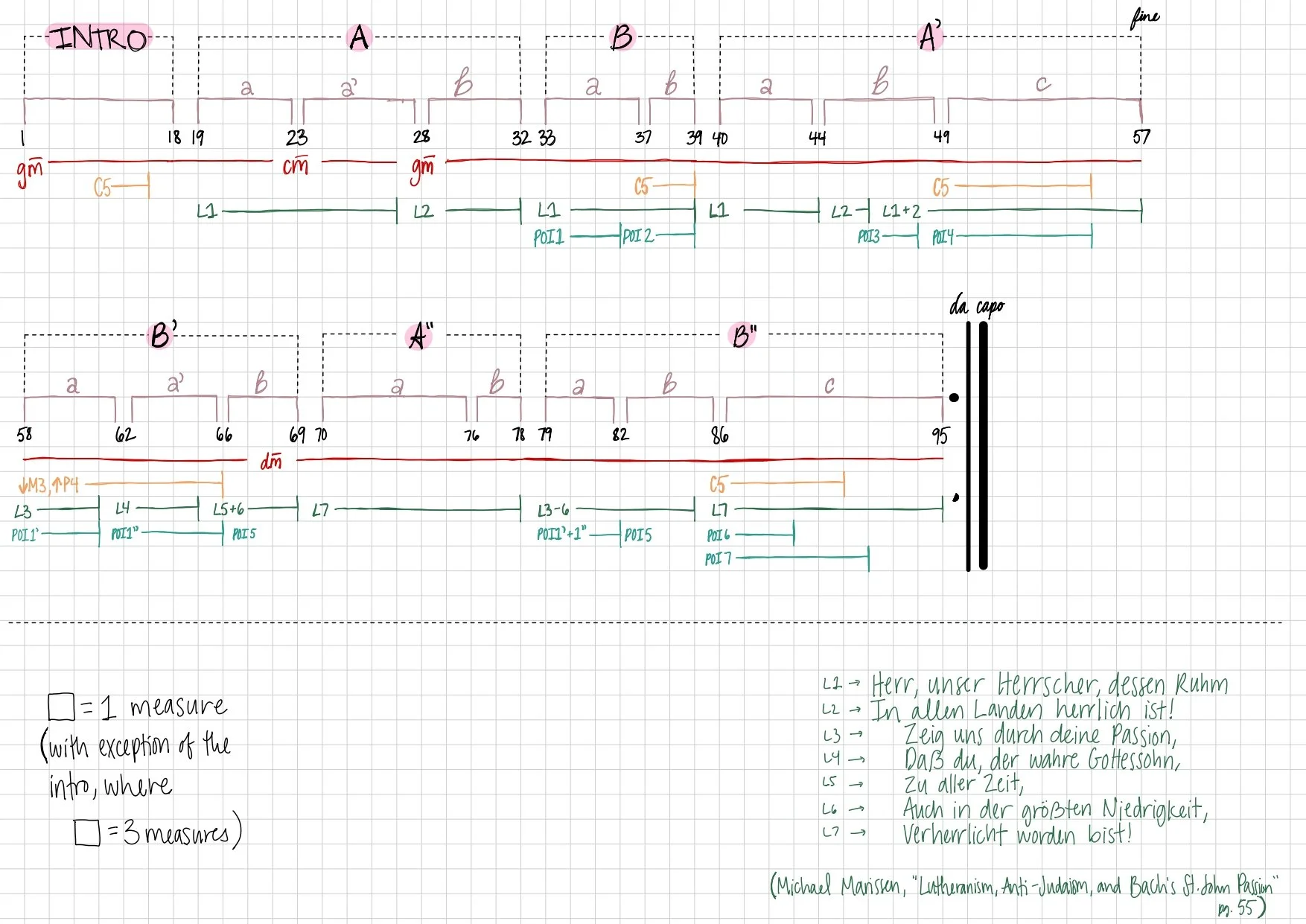
Figure 1
With its parts laid bare, we see that the opening chorus is not just about compositional technique—it communicates a clear idea. From the very beginning of the St. John Passion, Bach presents a tension that is never fully resolved: the coexistence of suffering and glory. As previously mentioned, this idea is central to the theology of John’s Gospel, in which Christ’s crucifixion is not simply an act of humiliation, but the very moment of his glorification.
This dualism is embedded directly in the text of “Herr, unser Herrscher,” and Bach’s setting amplifies it through musical means. The persistent minor mode, the dense imitative texture, and the sense of relentless motion all contribute to a sound world that feels weighted and unresolved. And yet, the text insists on majesty—Herrlichkeit—from the outset. As Chafe notes, the chorus attempts to express “glory and triumph within a movement that has all the outward signs of lamentation,” creating a tension that defines the listener’s experience of the work.
At the same time, this opening does not offer clarity or resolution. Instead, it establishes a distance between the human and the divine. The chorus addresses Christ in terms of majesty, but from a position that remains external, even remote. In Chafe’s reading, this reflects a fundamental limitation:
“…As long as God is presented in such a remote fashion, man has yet to learn the true meaning of the Passion. This is certainly Bach’s intention…The division of the ritornello material of the prologue into two parts—the first over a pedal point and emphasizing diatonic ascent, the second introducing circle-of-fifths harmony and a gradual chromatic descent—mirrors the shift from the eternal, unchanging God to the process of abasement leading to glorification.” (285)
In this sense, “Herr, unser Herrscher” functions as both prologue and frame. It presents the Passion not as a narrative to be followed step by step, but as a theological problem to be understood over a much longer period of time. From the very start, we are told that Christ is glorified in suffering—but we must work out the meaning of that claim across the course of the work itself. The music does not resolve the tension it creates. It sustains it, setting the stage for everything that follows.
In “Herr, unser Herrscher,” Bach does not attempt to resolve the tension between suffering and glory—he makes it the foundation of the movement itself.
Through imitation, sequence, and their resulting sense of continuous motion, Bach creates a structure that feels both fixed and inescapably forward-moving. What might initially sound like agitation or lament reveals itself, over time, as something more deliberate: a musical process that mirrors the theological claim at the heart of the Passion. Suffering is not separate from glory. It leads to it, and ultimately reveals it.
By the end of the chorus, nothing has been resolved. The listener has not been given clarity, only a framework for understanding. The Passion has not yet unfolded, but its meaning has already been declared.
In this way, the opening chorus does more than begin the St. John Passion. It defines the terms of the journey. Everything that follows will work within the tension it establishes, gradually reshaping it, but never fully escaping it.