Sustaining Stillness: Form and Performance
BWV 245.20 “Erwäge, wie sein blutgefärbter Rücken”
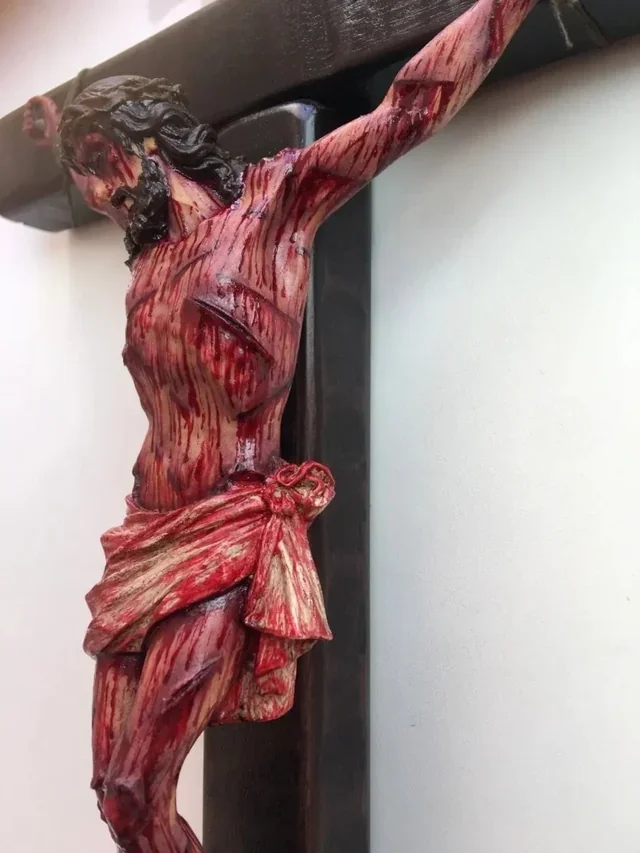
There’s a temptation, when you first encounter the Rainbow Aria, to think of it as a problem to solve. It’s long, the tessitura sits high, and its text repeats to the point that, on the page, it can feel almost static. There’s very little narrative movement, no obvious dramatic shifts, and few of the structural markers that typically help a singer shape an aria over time. At first glance, it raises a practical question: how do you sustain both voice and attention across something so unchanging?
For tenor Daniel Weeks, that challenge has been part of the aria’s appeal for decades. A frequent performer of Bach’s vocal works as both soloist and Evangelist, Weeks has lived with “Erwäge” for much of his career, returning to it again and again in performance. His perspective is shaped by years of experience—the accumulated decisions required to make this piece work in real time, in front of an audience. I sat down with Weeks to discuss the aria, and I’ve included his commentary in the discussion below.
This article builds on the dual perspectives of voice and attention, analyzing the aria across four dimensions. We’ll begin with the text itself, specifically its repetition and the interpretive challenges that follow. From there, we’ll look at how Bach structures the aria, using form, repetition, and rhythmic devices to create motion on the page. We’ll then turn to performance practice, considering how singers navigate breath, tessitura, tempo, and phrasing in order to sustain the line. Finally, we’ll place the aria back into its dramatic context within the St. John Passion, where its role becomes clearer as a moment of collective reflection rather than individual display.
Taken together, these elements point toward a single question at the heart of the piece: How does Bach deploy repetition and sustainment in service of drama that remains pertinent to contemporary performers?
Erwäge, wie sein blutgefärbter Rücken
In allen Stücken
Den Himmel gleiche geht,
Daran, nachdem die Wasserwogen
Von unsrer Sündflut sich verzogen,
Der allerschönste Regenbogen
Als Gottes Gnadenzeichen steht!
Imagine, how his bloodstained back
In all aspects
Is just like the sky.
Thereon, after the floodwaves
Of our sins’ deluge have passed by,
The most beautiful rainbow
Remains as a sign of God’s grace!
“Lutheranism, Anti-Judaism, and Bach’s St. John Passion” (Matthew Marissen)
Before getting too far into analysis, it’s worth sitting with the text itself. One of the striking things about this aria is how little textual material Bach is actually working with, and how much he draws out of it.
Even a quick glance reveals how compact this text is. Seven short lines, a single central image, and no narrative progression… just a sustained act of description. And yet, Bach stretches this material across one of the longest arias in the St. John Passion.
Bach achieves the aria’s length through extreme repetition. Figure 1 to the right charts the amount of times each noun in the aria’s text is repeated throughout. The most intriguing statistic here is that the word “Erwäge” alone is sung 22 separate times over the course of the aria (considering the da capo return). Visualizing the text in this way shows the urgency of the word “erwäge”… it is truly a plea for the congregation to reflect on the wounds that form Jesus’s sacrifice.
In the A section, this repetition happens at the level of small fragments: individual words and short phrases are reiterated, sequenced, and slightly varied, creating a sense of frequent looping. The B section, by contrast, abandons this micro-level repetition altogether. Instead, lines four through seven of the text are presented as a complete unit and then repeated in full, giving the B section a clear a-a’ structure.
The result is a text that doesn’t develop so much as it cycles. Rather than moving forward, it circles back, asking the listener to remain fixed on a single image for an extended period of time. Daniel Weeks frames this not as stagnation, but as intention:
“‘Erwäge’ can mean ‘consider,’ but it can also be ‘imagine’… Let’s just take a minute and really hold our gaze on Christ on the cross. Let’s just take a long look. Let’s drink in this image… I’m going to sing ‘Erwäge’ and I’m actually going to take you on the long look.”
In that sense, the aria functions less like a narrative and more like an act of sustained contemplation. This sense of repetition isn’t merely decorative. Rather, it asks the listener to not just observe the image, but to remain with it, to study it from every angle. In his book “Tonal Allegory in the Vocal Music of J.S. Bach",” musicologist Eric Thomas Chafe shows how this idea is seen throughout the entire St. John Passion:
“Meditation in the St. John Passion revolves around Jesus’ sacrifice as a benefit for mankind; in numerous movements, therefore, Bach (or an unknown librettist) used the Joannine device of inverting the immediate, literal meaning of the narrative events to bring out their soteriological interpretation.” (277)
Bach’s treatment of meditation in the St. John can be seen clearly in this aria’s message of redemption: that the blood on Jesus’ back forms rainbow patterns, a sign of the renewal of the covenant made with Noah after the flood.
However, this aria’s cyclical nature raises the piece’s central problem: how does something this repetitive avoid becoming static?
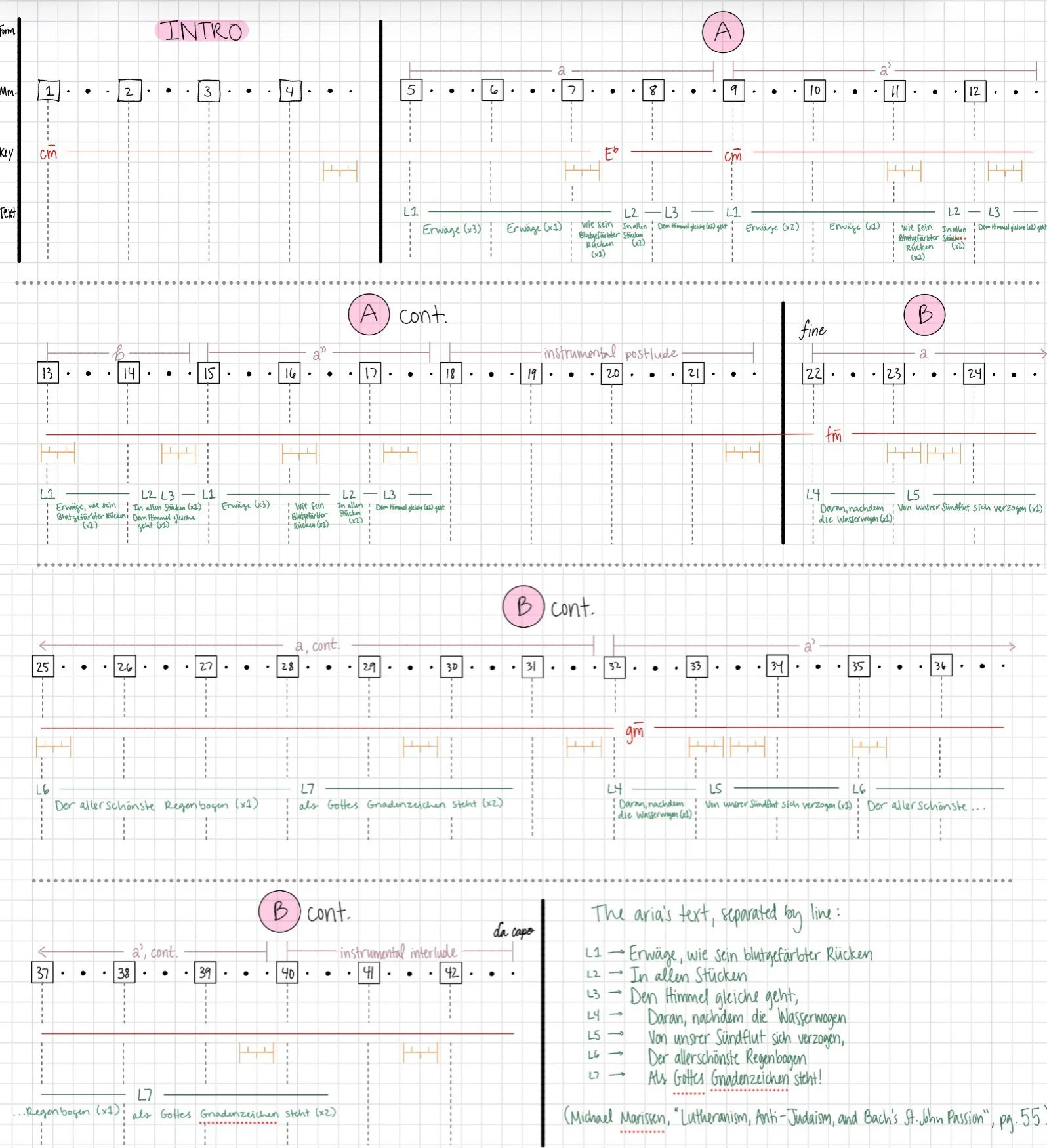
In terms of form, the Rainbow Aria doesn’t initially appear to offer a solution. Structurally, it follows a fairly conventional design: a four-measure instrumental introduction leads into the A section, which unfolds in an a–a’–b-a” pattern. A brief interlude connects to the B section, where the tonal center shifts from c minor to f minor (and later to g minor), and the text is presented in a clear a–a’ structure. After a short transition, the aria returns da capo to the A section before concluding with an instrumental postlude.
Within a conventional framework, though, Bach is constantly working against the risk of stagnation.
One of his most effective tools in doing so is the use of hemiola. Across the aria’s 63 measures, 26 contain at least 2 beats of hemiola, whether in the orchestra alone or in dialogue with the vocal line (that’s 41.2% of all measures in the aria). 14 of these instances occur within cadential passages. This, however, was not an innovation of Bach’s. In scholar Channan Willner’s article “The Two Length Bar Revisited: Handel and the Hemiola,” he explains that hemiola was commonly employed in cadential phrases during the Baroque period.
Nonetheless, Bach’s use of hemiola outside of cadential motion in this aria is still quite notable. In the B section, Bach goes even further: two measures are built entirely out of hemiola across all four beats, creating a brief but striking disruption of the prevailing meter. Even the instrumental interludes participate in this process: each of the five interludes closes with a hemiola gesture, preventing them from functioning as simple moments of release.
The effect is cumulative. Rather than allowing the listener to settle into a predictable rhythmic pattern, Bach continually shifts the listener’s sense of the big beat. Nowhere is this more apparent than in mm. 11-17, where nearly every measure contains some degree of hemiola. The lone exception, m. 15, marks the return of the repeated “Erwäge, erwäge, erwäge” motive heard earlier in the aria, momentarily re-grounding the texture before the instability resumes.
All of these details are mapped in the form chart I devised, referenced as Figure 2 (to the right).
Figure 2 presents the aria in full, outlining its large- and small-scale form, key areas, and patterns of text repetition. Instances of hemiola are indicated by the orange symbols, and lines of text are labeled L1-7 according to the scheme adapted from Michael Marissen’s Lutheranism, Anti-Judaism, and Bach’s St. John Passion (p. 55), which can be seen in the bottom right corner.
Seen in this way, the aria begins to look very different from how it first appears on the page. What initially feels static reveals itself as highly active beneath the surface. By subtly reshaping the rhythmic landscape through hemiola, Bach provides the performer with a constantly shifting framework: one that invites (and even demands) interpretive response.
Figure 1
Figure 2
If Bach provides the framework, the burden of sustaining the aria ultimately falls on the performer. And in “Erwäge,” that burden is significant.
For Weeks, the challenge begins with something fundamental:
Riedel: What are the biggest technical challenges of this aria for a tenor, and how do those challenges influence your interpretation?
“Breath. Breath’s the big one in this piece. I think, to sing this aria, a tenor has to breathe like they know what they’re doing. Every breath is important. You’ve got to get a good tank, but then you have to manage said tank.”
The length of the phrases and the consistently high tessitura mean that breath isn’t only a technical concern, but truly the foundation of interpretation. Without careful planning, the musical line simply can’t be sustained. But even with planning, the aria resists rigidity:
“The first couple of times a person works on it and starts getting it into their repertoire, the breaths aren’t going to be there. It takes a while to get them into your body, and that’s fine.”
In other words, this is a piece that has to be lived in. Technique develops over time, and with it, the ability to shape longer arcs across the aria.
That shaping becomes even more critical given the tessitura. The vocal line sits persistently high, requiring not just endurance but a kind of constant forward motion in the stream of air. Weeks describes it this way:
“It hangs high. So to me, that’s connected to breath; when you’re managing the breath you’ve taken in, you need to make sure you’re keeping yourself lifted and arched. Everything that you sing is coming over and in front of where you’ve just been. If the line goes down, you don’t let yourself go down in your technique.”
The result is a balancing act between control and flexibility. This balancing act is not felt by the singer alone, however.
In performance, “Erwäge” is not a solo in isolation, but a collaboration, particularly with the obbligato viola d’amore. Weeks describes this relationship in almost physical terms:
“We’re totally dancing together… it’s a give and take of what they’re doing and what I do as a singer.”
In a fine performance, a singer cannot simply project over the ensemble. They must respond to it—matching gesture, shaping phrases in tandem, and remaining sensitive to the instrumental line.
At the same time, the broader structure of the aria places demands on pacing that extend to the conductor as well. According to Weeks, maintaining momentum is essential for the piece to function.
“This is one of those pieces that has to be performed in the tempo I need it to be performed in. There’s not a lot of leeway. You can feel it in twelve, okay. But it really needs to be felt in four. It can’t be felt in a twelve that’s so slow that you lose where the fours are. If you do that, this really becomes twelve and a half minutes of singing high Gs—and you just can’t sustain that. I want to keep those Gs spinning. ... The tempo is the biggest thing, and you can’t let it get slow. … I find that if you’ve got a conductor who’s a singer and who gets singers, you’re golden. But if you have one that doesn’t, you might just have to push some things when you can.”
Without that underlying sense of motion, the very repetition that gives this aria its character begins to work against it. What should feel like sustained attention instead becomes stagnation.
It can be said, then, that the technical demands of the aria not only shape interpretation, but truly limit it as well. Choices about phrasing, dynamics, and expression are all filtered through the physical constraints of breath, range, and endurance.
All of these decisions—breath, tempo, collaboration—serve something larger than technical success. They shape how the aria is perceived in the moment, and whether it fulfills the role Bach seems to have intended for it. Because “Erwäge” is not simply an opportunity for vocal display; it’s a point of reflection within the larger structure of the Passion. The singer is not just navigating difficulty, but guiding the listener through an extended act of contemplation. This invitation to reflect reaches beyond the individual performer and begins to draw in the entire audience.
Placed where it is in the St. John Passion, “Erwäge” does not function as a moment of forward motion. Much like in Italian opera, where recitative propels dramatic action and aria provides space for reflection, this movement interrupts the narrative at a point of extreme tension and asks something different of the listener: not to follow the story, but to dwell within it.
For Weeks, this shift is essential to understanding the aria’s role. Within the larger architecture of the passion, each musical force occupies a different dramatic space: the Evangelist narrates, the chorus embodies the crowd, and the chorales give voice to the congregation. The arias, however, operate on a more intimate level:
“You’ve got the soloists, who are the people standing at the altar, pouring their hearts out. Sometimes it’s very intimate, where it’s just themselves and God. Other times, it turns around and encompasses the congregation.”
“Erwäge” belongs firmly to the latter category.
Rather than acting as a private reflection, the aria expands outward, forcing the listener into the act of contemplation. This invitation reframes the role of the performer. The singer is not only interpreting the aria for an audience, but acting as a kind of guide, holding the image in place long enough for others to engage with it. The repetition, then, is not just a compositional device or a technical challenge, but also a mechanism by which that communal reflection is made possible.
It also helps explain why the aria can feel so difficult for modern listeners. The text demands sustained attention to an image that is, at first glance, uncomfortable.
“To really do this aria justice, you have to come to grips with that and sing it as if it’s a fantastic thing… To really stop and stare. Look. Reflect. Think. Don’t turn away.”
The Rainbow Aria resists the instinct to move on, or to resolve the tension quickly. Instead, it insists on stillness. In this sense, “Erwäge” stands as a hinge point within the Passion—not because it advances the story, but because it deepens it. It transforms narrative into meditation, and individual expression into shared experience. And in doing so, it reveals something fundamental about Bach’s approach to drama: sometimes the most powerful movement comes not from motion, but from the willingness to remain still.

To find out more about Prof. Daniel Weeks, visit http://www.tenorweeks.com/.
In the end, “Erwäge” never stops being what it first appears to be. It is long. It is repetitive. It lingers on a single image far longer than feels comfortable. What changes is how we come to understand these properties.
The text provides the constraint: a limited set of words, circling the same idea again and again. The composition responds by introducing motion beneath the surface, most notably through the destabilization of meter. The performer, in turn, animates that framework, shaping breath, pacing, and collaboration into something that feels alive in real time. And within the larger context of the St. John Passion, all of these elements combine to create something greater than the sum of their parts: a sustained moment of communal reflection.
What initially feels static reveals itself as deliberate. What feels repetitive becomes insistent. What seems like stillness becomes depth.
Bach keeps this aria alive not by escaping its limitations, but by transforming them into opportunities for variation, interpretation, and meaning. The performer’s task is to do the same: to remain within the frame, resist the urge to rush forward, and to trust that, with enough attention, the image will continue to unfold.